
Spin The Top, 35mm Photograph, SameSource, 12 Inches of Sin VIII, Le Salon des Refusés Péché
We are so glad you like this piece. We do, too! Please complete this form so that we may connect you with the artist. We hope you decide to add this beautiful work of art to your collection.
Art Inquiry
DESIRE IN SUSPENSION: MOTION, SHADOW, AND THE EROTICS OF U NCERTAINTY — SPIN THE TOP
35MM PHOTOGRAPH
THE BODY AS EVENT, NOT OBJECT
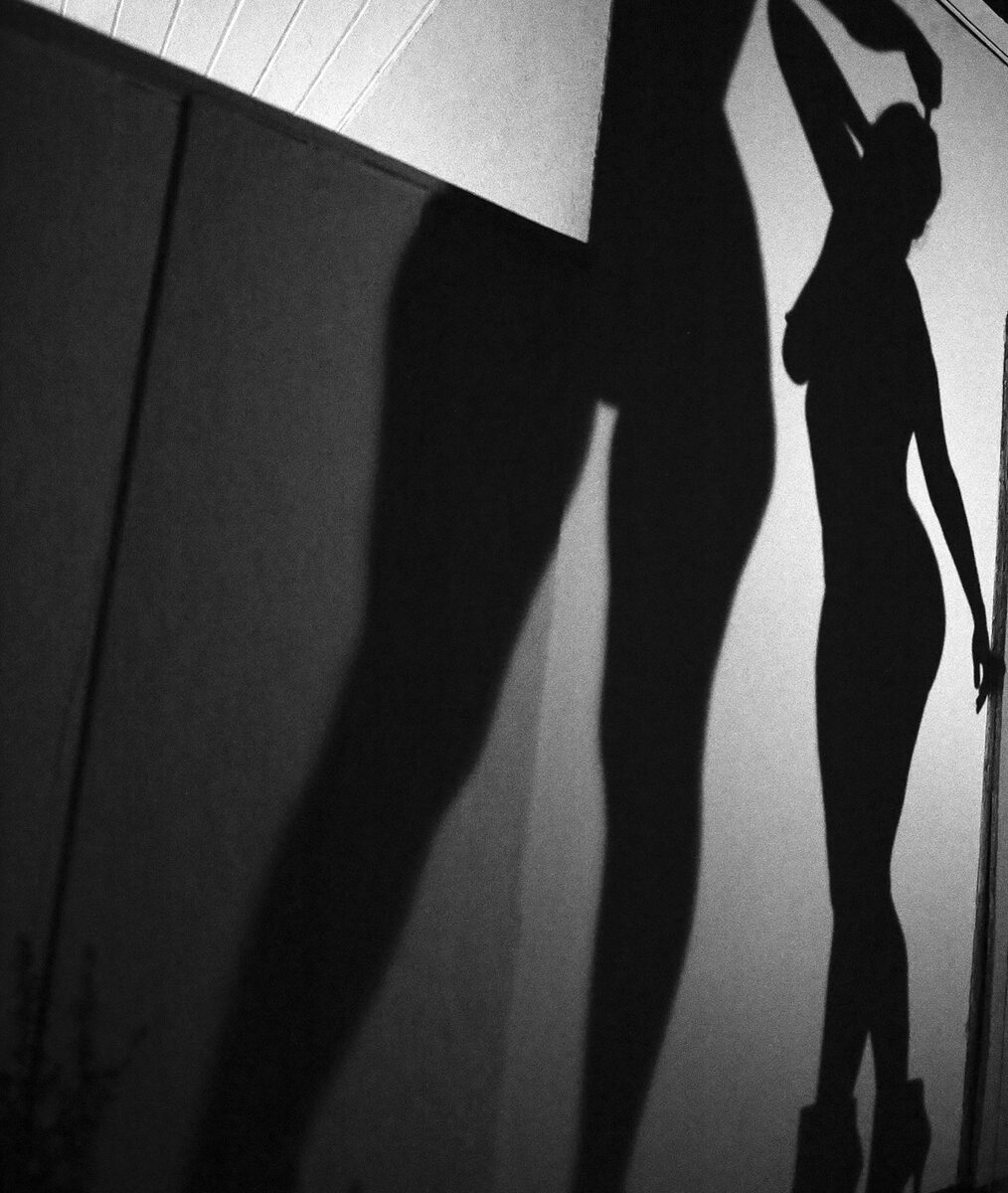
In Spin the Top, the body does not announce itself through form but through consequence. What dominates the frame is not flesh, but its echo: an elongated shadow stretched across the wall, shaped by motion rather than anatomy. One arm arcs upward in a gesture that feels both deliberate and involuntary, as if the figure is obeying a physics beyond conscious control. The image does not reveal what the body is. It reveals what the body does when it yields to light, momentum, and imbalance.
For SameSource, eroticism emerges not through exposure but through displacement. The figure is doubled, distorted, and re-authored by shadow, becoming less a subject than an event. What we witness is not an erotic body in space, but the trace of a body negotiating gravity, rhythm, and disappearance. Desire enters sideways—through tension, through delay, through the unstable interval between presence and dissolution. This is not a photograph that asks to be read. It asks to be followed.
MOTION AS EROTIC LANGUAGE
The power of this image lies in its commitment to movement as the primary carrier of erotic charge. The body twists, the shadow swells, and the figure seems perpetually on the verge of both arrival and disappearance. The photograph does not freeze eroticism into a consumable still. It renders it kinetic, unstable, and unfolding.
The spinning gesture is crucial. As an action, spinning is associated with childhood play, trance, ritual, and loss of equilibrium. Here, that same rotational energy becomes eroticized—not through nudity or explicit touch, but through surrender to motion. The body yields to centrifugal force. Control and abandon coexist, forming an implicit architecture of dominance and submission enacted not through spectacle, but through the physics of imbalance.
What emerges is an image of desire as a physical instability rather than a visual claim. The erotic here does not assert itself. It wavers.
THE BODY AS SHADOW ARCHITECTURE
In Spin the Top, the shadow is not secondary to the figure; it is the figure’s dominant expression. The projected body becomes taller, darker, and more commanding than the physical source that casts it. Light does not clarify form. It enlarges mystery.
This reversal destabilizes the traditional hierarchy of photographic representation. The “real” body withdraws into obscurity while its immaterial double takes command of the frame. Eroticism is relocated from flesh to projection, from substance to illusion.
The shadow functions as both presence and erasure. It confirms the body’s existence while denying its details. In this way, SameSource constructs an eroticism grounded not in touch, but in distance made visible.
TIME, BLUR, AND THE REFUSAL OF CAPTURE
Although the work is a still photograph, it is saturated with time. The elongation of the shadow and the partial blur at the edges of the figure suggest extended exposure, a slippage between instants. The camera does not capture a decisive moment. It accumulates moments.
This strategy places the work in dialogue with the history of photographic motion studies, from the analytic sequences of Eadweard Muybridge to the dream-distortions of Man Ray. Yet where those artists used motion to study mechanics or fracture reality into abstraction, SameSource directs motion toward the instability of desire itself. The camera becomes an instrument not of certainty, but of erosion. The more the body moves, the less it can be fully known.
EROTICISM WITHOUT CLARITY
The photograph refuses the dominant visual logic of contemporary erotic culture, which demands ever-greater visibility, immediacy, and anatomical certainty. Here, the erotic body never arrives in full. It is always becoming. Always slipping.
This refusal is not coyness. It is philosophical positioning. SameSource situates erotic power in what resists disclosure, not in what yields to it. The photograph insists that desire is not fueled by completion, but by the gap between what is seen and what is imagined. The viewer’s gaze is therefore never sovereign. It is destabilized by motion, misled by shadow, and denied the authority of full recognition. Erotic vision becomes speculative rather than acquisitive.
DESIRE AS INSTABILITY
The symbolic logic of play condenses into erotic motion. A spinning top exists only through temporary balance; once movement collapses, so does identity. That same condition transfers onto the body itself.
SameSource structures erotic presence through motion rather than form. Through shadow, the figure is stripped of personal specificity and rendered an anonymous architecture of projection.
The photograph was taken inside a 1959 midcentury modern Alexander Butterfly home in Palm Springs, where rigid architectural edges and controlled lighting collide with the soft curves and vulnerable velocity of the body, sharpening the tension between structure and surrender.
Spin the Top was recognized as Best Fine Art Nude Photograph at the Lucie Foundation’s 19th Annual International Photography Awards. The image refuses familiar conventions of display and insists on disturbance as power. The photograph does not resolve into clarity. The viewer is invited into motion, where desire is never fully still.
Enjoy the 12 Inches of Sin VIII Art Catalog here!