
Kodak Venus, Digital Collage, Gaspar Marquez, 12 Inches of Sin VIII, Le Salon des Refusés Péché
We are so glad you like this piece. We do, too! Please complete this form so that we may connect you with the artist. We hope you decide to add this beautiful work of art to your collection.
Art Inquiry
DESIRE IN THE AFTERIMAGE: KODAK VENUS
DIGITAL COLLAGE (PHOTOGRAPHY-BASED)
MYTH, MEDIA, AND THE FRACTURED BODY OF REPRESENTATION
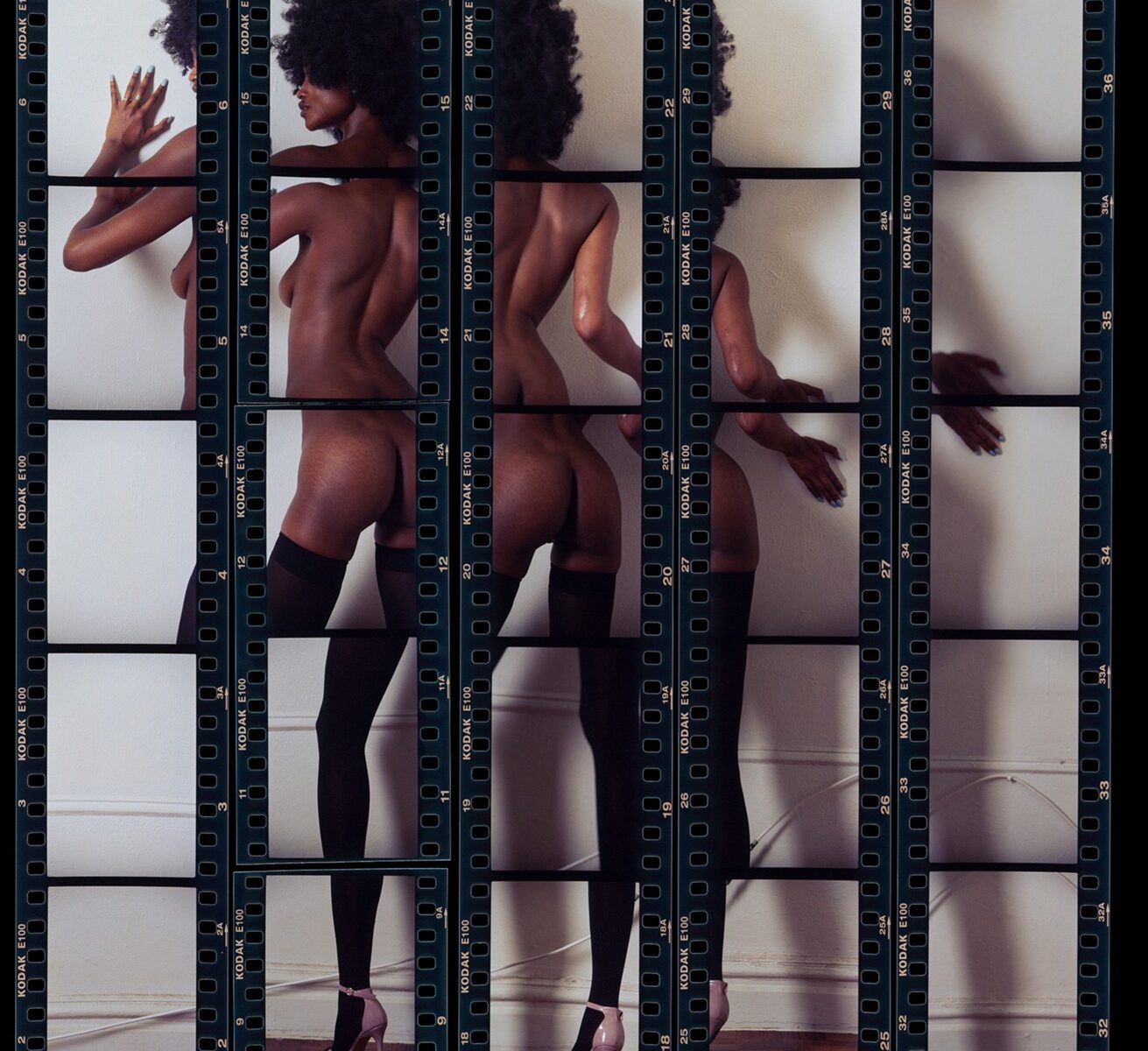
Kodak Venus by Gaspar Marquez unfolds as a body in sequence—an erotic presence stretched across strips of photographic time, repeated, interrupted, and reassembled through the architecture of film. The figure appears in fragments, revealed and concealed by the black frames of perforated negatives. She is at once continuous and broken, fluid and obstructed. Desire arrives through rhythm rather than immediacy, through accumulation rather than singular exposure. What feels private is rendered cinematic. What feels mythic is made reproducible.
The title itself stages the work’s central tension. By pairing “Kodak,” an emblem of mass photography’s golden age, with “Venus,” the ancient goddess of love and erotic beauty, Marquez collapses centuries of visual history into a single mediated body. The goddess no longer rises from the sea. She emerges from film stock, contact sheets, and mechanical repetition. The result is not parody. It is translation.
This is the central tension of Marquez’s practice: eroticism that exists not in singular revelation, but in reproduction. The body is present, but never whole at once. Intimacy is visible, but never uninterrupted. What emerges is not a static icon of desire, but a meditation on how the erotic now circulates through fragments, frames, and technological segmentation.
THE BODY AS SEQUENCE
Unlike traditional nudes that aim for compositional unity, Kodak Venus disperses the figure across vertical film strips. Each frame captures a slight shift in posture, gesture, and weight. The body becomes cinematic rather than sculptural. Desire unfolds through progression rather than by possession.
This fragmentation is not incidental—it is structural. The perforated borders impose rhythm, delay, and interruption. The viewer’s gaze is forced to move sequentially, to track the body through partial revelations. The erotic here is not immediate. It is cumulative. The image teaches the viewer how to look by controlling how the body is unveiled. In this way, Marquez transforms the nude from a destination into a temporal experience. The body is not consumed. It is followed.
PHOTOGRAPHY AS ARCHITECTURE
The use of photographic film as both subject and structure is essential to the work’s conceptual force. The negative frames do not merely contain the image; they regulate it. They behave like visual gatekeepers, deciding what portion of the body may appear and when.
This strategy reframes photography not as a transparent window onto the erotic, but as an architecture of control. The camera does not simply reveal. It disciplines, segments, and sequences. The body is filtered before it ever reaches the eye. In Kodak Venus, photographic technology is no longer a neutral tool of preservation. It becomes an active participant in the construction of desire.
VENUS AFTER REPRODUCTION
By invoking Venus, Marquez places the work in dialogue with centuries of idealized erotic form. Yet this Venus does not arrive as marble, oil, or mythic flesh. She arrives through emulsion, exposure, shadow, and time-stamped repetition. She is not singular. She is multiplied.
The goddess is not eternal because she is perfect. She is eternal because she is endlessly iterative. Each frame is a variation rather than a copy.
The body persists through difference rather than stasis. Beauty is no longer fixed. It is versioned. This shift reflects a fundamental condition of contemporary erotic culture: desire no longer revolves around the original. It revolves around the feed, the archive, the scroll.
THE EROTICS OF INTERRUPTION
What distinguishes Kodak Venus from nostalgic tribute is its insistence on obstruction. The viewer is never given the body without interference.
Film borders cut across limbs. Negative space interrupts contours. The gaze is constantly reminded of the medium’s presence.
This produces a specific psychological effect. The body is always near, but never fully accessible. The erotic here is not organized around mastery. It is organized around deferral. Desire is sustained not by gratification, but by interruption. Marquez reframes longing as a temporal condition rather than a purely visual one. The erotic becomes something that unfolds through waiting, repetition, and partial access.
DESIRE AS AFTERIMAGE
Marquez’s transition from photography into collage is not a rejection of the camera, but an expansion of its critical potential. By cutting, re- sequencing, and re-contextualizing photographic material, he disrupts the authority traditionally granted to the photographic image as truth. In Kodak Venus, photography is honored for its intimacy and immediacy, but it is also fractured for its role in standardizing beauty. The body is no longer trapped in a single authoritative exposure; it escapes through series, variation, and interruption. Here, collage becomes not merely a technique but a philosophy: identity, desire, and representation are always composite, never whole.
Ultimately, Kodak Venus frames eroticism as a condition shaped by spectacle and repetition rather than possession. The body moves between reverence and obstruction, between exposure and withdrawal. Desire lingers as sequence and afterimage. The viewer must move with it, interruption by interruption, where the goddess survives not as an object of mastery but as a rhythm still becoming.
Enjoy the 12 Inches of Sin VIII Art Catalog here!