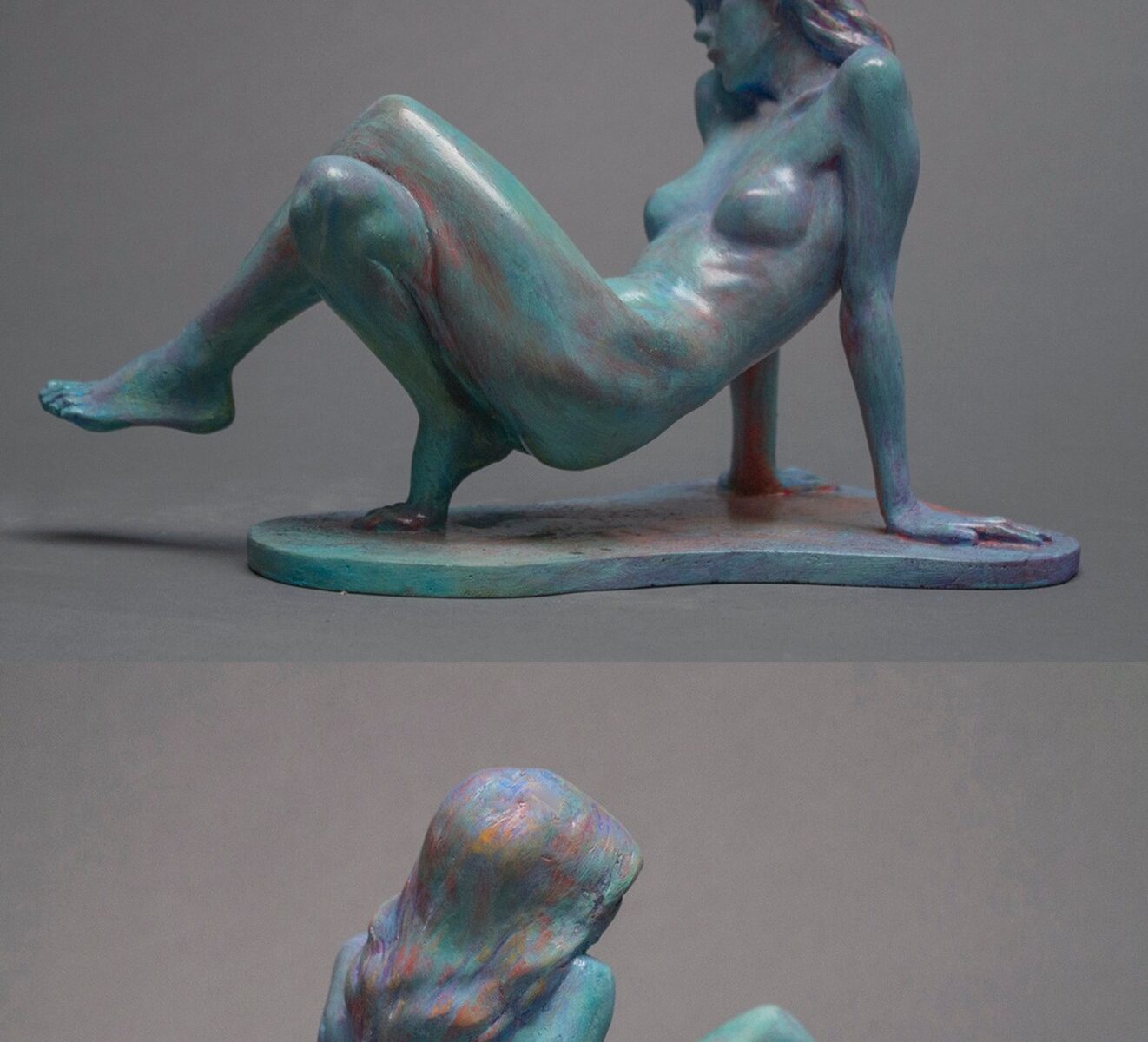

Leda, Aquastone, Dominique St. Cyr, 12 Inches of Sin VIII, Le Salon des Refusés Péché
We are so glad you like this piece. We do, too! Please complete this form so that we may connect you with the artist. We hope you decide to add this beautiful work of art to your collection.
Art Inquiry
REIMAGINING MYTH IN AQUASTONE AND IRIDESCENCE: LEDA
AQUASTONE
THE MYTH WITHOUT THE SWAN
In Leda, Dominique St. Cyr reaches deep into classical mythology to recover something often overlooked: the woman. Where so many depictions of the ancient Greek tale emphasize Zeus’s violent intrusion
—as a swan descending upon the mortal Leda—St. Cyr offers no such spectacle. Her Leda stands alone, fully sculpted, resolutely present. The god is gone. The myth, unmade.
Crafted in AquaStone—a durable, water-based sculpting medium—the figure bears a luminous surface treatment that suggests both oceanic shimmer and atmospheric oxidation. Shades of turquoise, coral, and violet swirl over the textured surface like mineral veins exposed by erosion or time. This patina is not simply decorative; it breathes life into the work, cloaking it in a chromatic tension between beauty and exposure, surface and story.
A GESTURE OF REST, NOT SEDUCTION
Unlike traditional depictions of Leda, which center her as an object of seduction, submission, or collapse, St. Cyr’s figure rests. Her body is posed in relaxed symmetry, one knee gently lifted, arms lowered into an almost private quiet. There is no performance here, no invitation to be consumed. Instead, there is rest. A quiet anchoring.
This stillness inverts the aesthetic logic of classical violation. By denying the viewer the narrative climax of intrusion, St. Cyr reframes Leda not as a victim to be observed but as a presence to be encountered. Her form does not react. It asserts itself.
MATERIAL AS METAPHOR
St. Cyr’s choice of AquaStone further underscores the transformation at the heart of this work. AquaStone begins in liquid form, shaped by the artist’s hands, then hardens in air. It is a material that embodies endurance through change. In its final state it appears both fragile and immovable, mute yet expressive.
The surface patina thickens this paradox. Iridescent hues glow against oxidized shadows, as if the figure has passed through corrosion and emerged intact. The body looks as though it has been weathered by forces beyond its choosing, yet held together by internal cohesion rather than fracture. This physical logic aligns quietly with St. Cyr’s lifelong artistic focus on the architecture of the body under pressure— how form absorbs trauma, memory, and exposure without surrendering its center.
ABSENCE AS POWER
The absence of Zeus—the notorious swan—speaks volumes. By removing the aggressor, St. Cyr removes the mechanism of spectacle. There is no violence to witness. There is only aftermath, and from that, agency.
The result is not a moment of mythic rupture but one of mythic refusal. The narrative dissipates. The hierarchy collapses. What remains is not the record of a god’s dominance, but the enduring sovereignty of a woman who will not be absorbed by someone else’s legend.
RECLAIMING THE GAZE
St. Cyr does not ask the viewer to decode her figure through a fixed meaning. Instead, she invites a longer looking. The figure does not demand attention; she holds it. She does not perform for the viewer; she resides within herself.
This is a reversal of the historical gaze that has so often reduced women to allegory, to symbol, to surface. In Leda, the woman remains opaque to extraction. The viewer must confront their own expectation of narrative completion—and be denied it.
What does it mean to look at a woman who will not play the part? St. Cyr’s work exists precisely within that question.
FROM MYTH TO MONUMENT
Ultimately, Leda is not a sculpture of a myth. It is a monument to interior authority. The figure stands not as archetype but as endpoint. The myth no longer frames her. She frames herself.
This posture reflects a broader throughline in St. Cyr’s life and work—an artistic practice shaped by proximity to extreme power, consumption, secrecy, and survival, yet consistently returning to endurance as its core grammar. Rather than narrating trauma, St. Cyr transforms it into structure. The body is no longer the site of damage. It becomes the site of authorship.
In this way, Leda is not simply Leda anymore.
It is a body that has passed through myth and arrived at self-possession. And in that arrival, everything changes.
Enjoy the 12 Inches of Sin VIII Art Catalog here!