
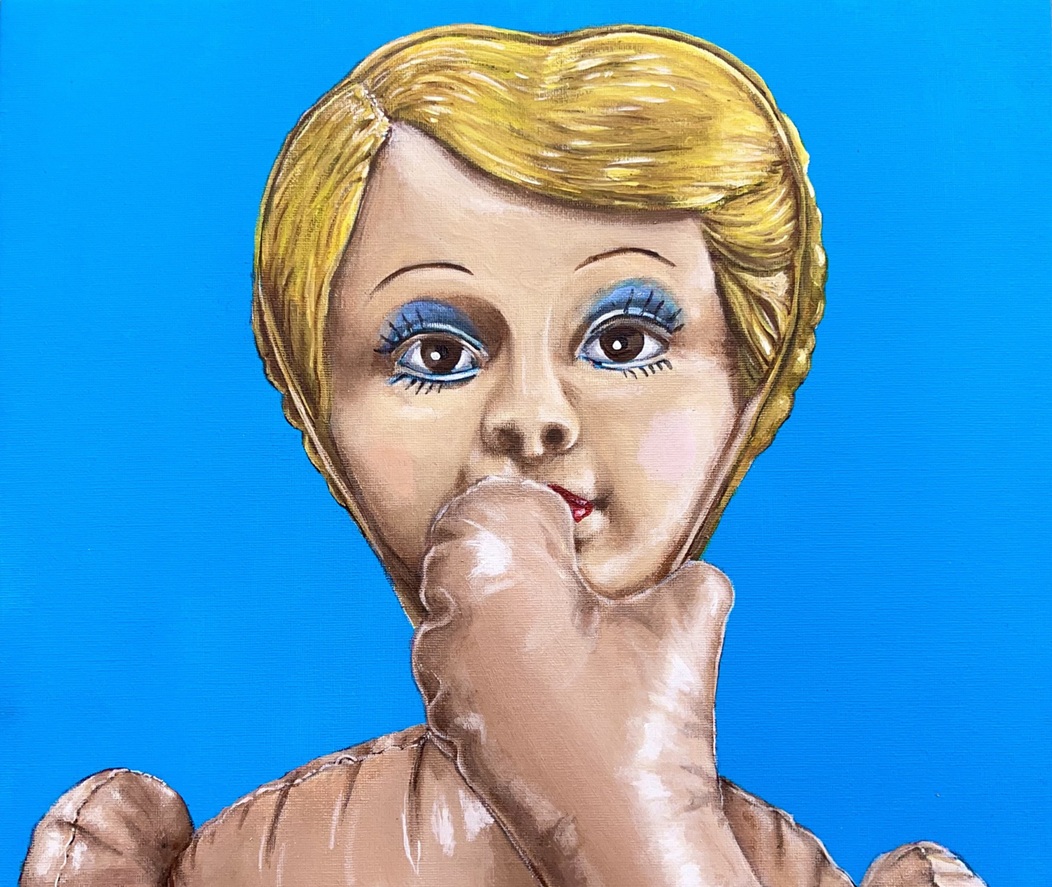
Quiet Pretty Things: Eye Candy, Selective Hearing And Lip Service, Triptych, Acrylic on Canvas, Kimberly Renee, 12 Inches of Sin VIII, Le Salon des Refusés Péché
We are so glad you like this piece. We do, too! Please complete this form so that we may connect you with the artist. We hope you decide to add this beautiful work of art to your collection.
Art Inquiry
THE DISCIPLINE OF DESIRE IN THREE COMMANDS: QUIET PRETTY THINGS—EYE CANDY, SELECTIVE HEARING AND LIP SERVICE
Triptych, Acrylic on Canvas
THE OBEDIENCE OF SPECTACLE
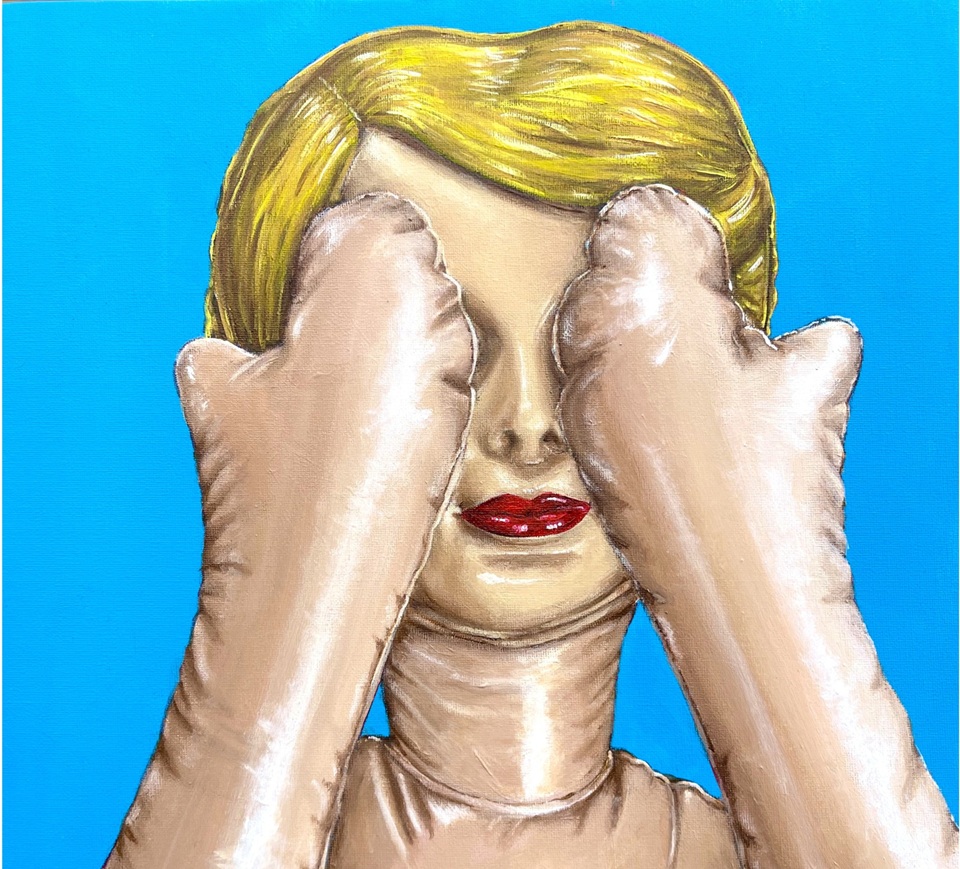
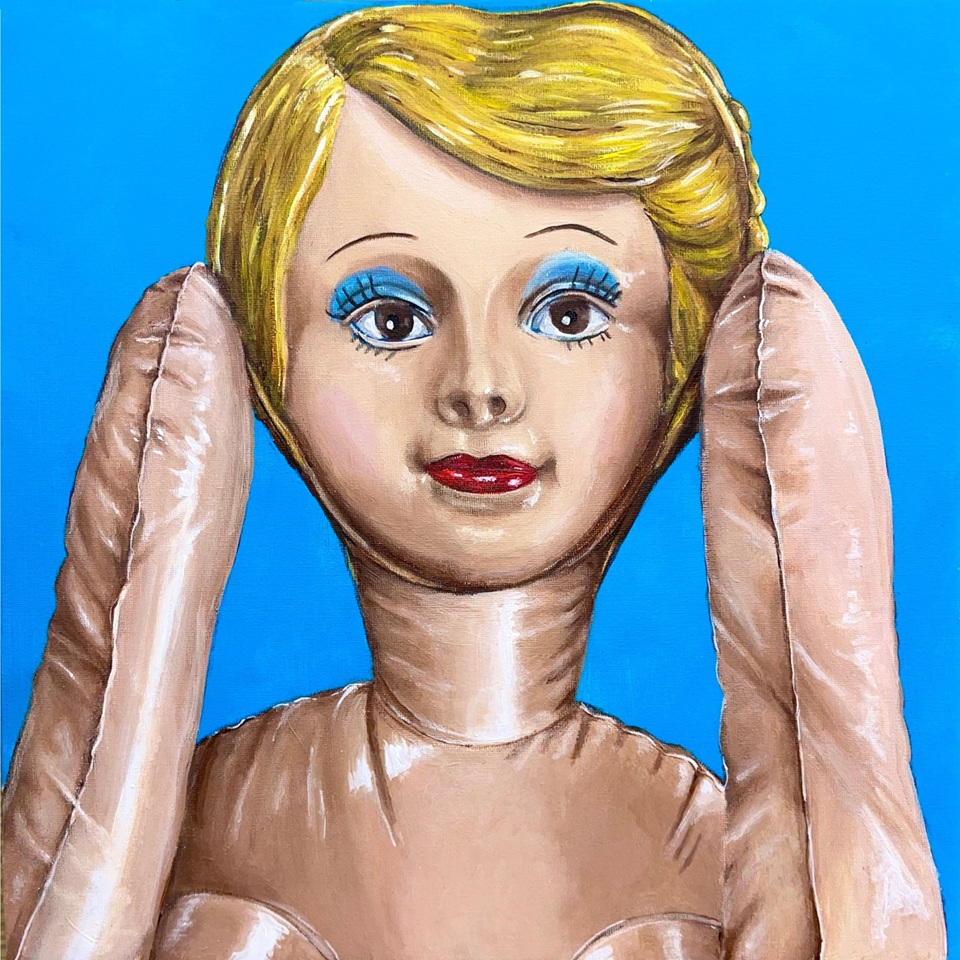
At first glance, Quiet Pretty Things, by Kimberlyn Renee, shimmers with humor, fluorescent color, and the disarming familiarity of an American cultural artifact. Across three acrylic-on-canvas panels, the figure of Judy performs the moral injunctions of “See No Evil, Hear No Evil, Speak No Evil” with exaggerated obedience. The triptych unfolds across three panels—Eye Candy, Selective Hearing, and Lip Service—each structurally aligned with these commands. Rendered in high-voltage pop color and staged as visual theater, the work initially appears playful. Yet beneath that buoyant surface, it unfolds as a precise critique of how visibility, sexuality, and control continue to shape the female body across generations.
ARTIST AS INTERRUPTION
A St. Louis–based, self-taught surrealist pop artist, Renee works at the intersection of fluorescent fantasy, cultural iconography, and social satire. Known for her high-energy color and nostalgic imagery, her practice frequently incorporates UV-reactive pigments, phosphorescent surfaces, and three-dimensional elements that allow each painting to shift across states of perception.
Renee’s work speaks directly to the inner child not as refuge, but as a site of imaginative disruption. Wonder becomes a strategy rather than a diversion. That sensibility is central to Quiet Pretty Things, where fantasy operates simultaneously as surface delight and critical engine.
FROM TABOO TO INFRASTRUCTURE
Long before today’s technologically simulated companions, Judy served as one of America’s first mass-market feminized proxies. Once considered obscene, the blow-up doll later became a cultural gag and, eventually, even a utilitarian object deployed as a decoy passenger in carpool lanes. What was once forbidden became humorous. What was once hidden became infrastructure.
This transformation does not signal liberation so much as reabsorption. Obscenity dissolves not through justice, but through neutralization. Judy becomes acceptable only after she becomes unserious. In that shift, sexualized femininity does not disappear. It is converted into function, stripped of agency, and folded into the logic of the everyday.
THE ILLUSION OF PROGRESS
If the Victorian era governed women through concealment, the contemporary world governs through compulsory visibility. Skin is no longer a violation but an expectation shaped by cultural demand.
Control has shifted from restriction to saturation.
Visibility now masquerades as freedom. Desire is recoded as empowerment. Yet the contradiction endures: women remain bound to a visual economy that governs worth through legibility, desirability, and performance. The mechanism has evolved. The hierarchy has not.
MANUFACTURED FEMININITY
Within this structure, Judy becomes the perfected ideal of manufactured womanhood: hollow, inflatable, compliant, and replaceable. She embodies the paradox assigned to women across time. Be pure, yet available. Be moral, yet sexual. Be sacred, yet disposable. The triptych stages these contradictions not through subtle metaphor but through exaggerated moral theater.
In Eye Candy, the command to be seen becomes an obligation to be consumable. Vision becomes currency, and the body flattens into spectacle. In Selective Hearing, obedience is negotiated through curated attention, where what is heard is filtered through convenience and denial. In Lip Service, speech becomes performance rather than agency, reduced to scripted participation within a moral economy that rewards appearance over truth.
ILLUSION AND DISCIPLINE
The cultural trajectory embedded in Quiet Pretty Things follows a familiar arc. Taboo becomes joke. Joke becomes tool. Tool becomes critique. Yet absorption into everyday use does not equal equity. Acceptance often arrives only after power is disguised as humor.
Satire becomes the artist’s primary instrument. The triptych does not shout its warnings; it disarms with fluorescence, absurdity, and nostalgic charm. Laughter opens the door through which critique quietly enters.
The work exposes how spectacle substitutes for liberation, how desire is permitted only when it no longer disrupts the system that consumes it.
FUTURE GENERATIONS
If Judy represents a lineage of imposed silence, Renee’s reanimation of her suggests something else entirely. Obedience is revealed as performance rather than fate. The triptych exposes the script precisely so it can be revised.
Progress, the work suggests, may not arrive as rupture from history. It may emerge through recognition, re-narration, and the willingness of future generations to identify pattern clearly enough to refuse its inevitability. In this way, fantasy becomes not distraction but strategy. Nostalgia becomes a tool of interrogation rather than retreat.
The artwork holds two truths in suspension. The first is sobering: the contradictions governing femininity have proven remarkably durable. The second is hopeful: visibility can still be reclaimed, imagination can still interrupt, and even the most hollow icon—once illuminated by critical consciousness—can be transformed from instrument of compliance into a site of resistance.
Enjoy the 12 Inches of Sin VIII Art Catalog here!