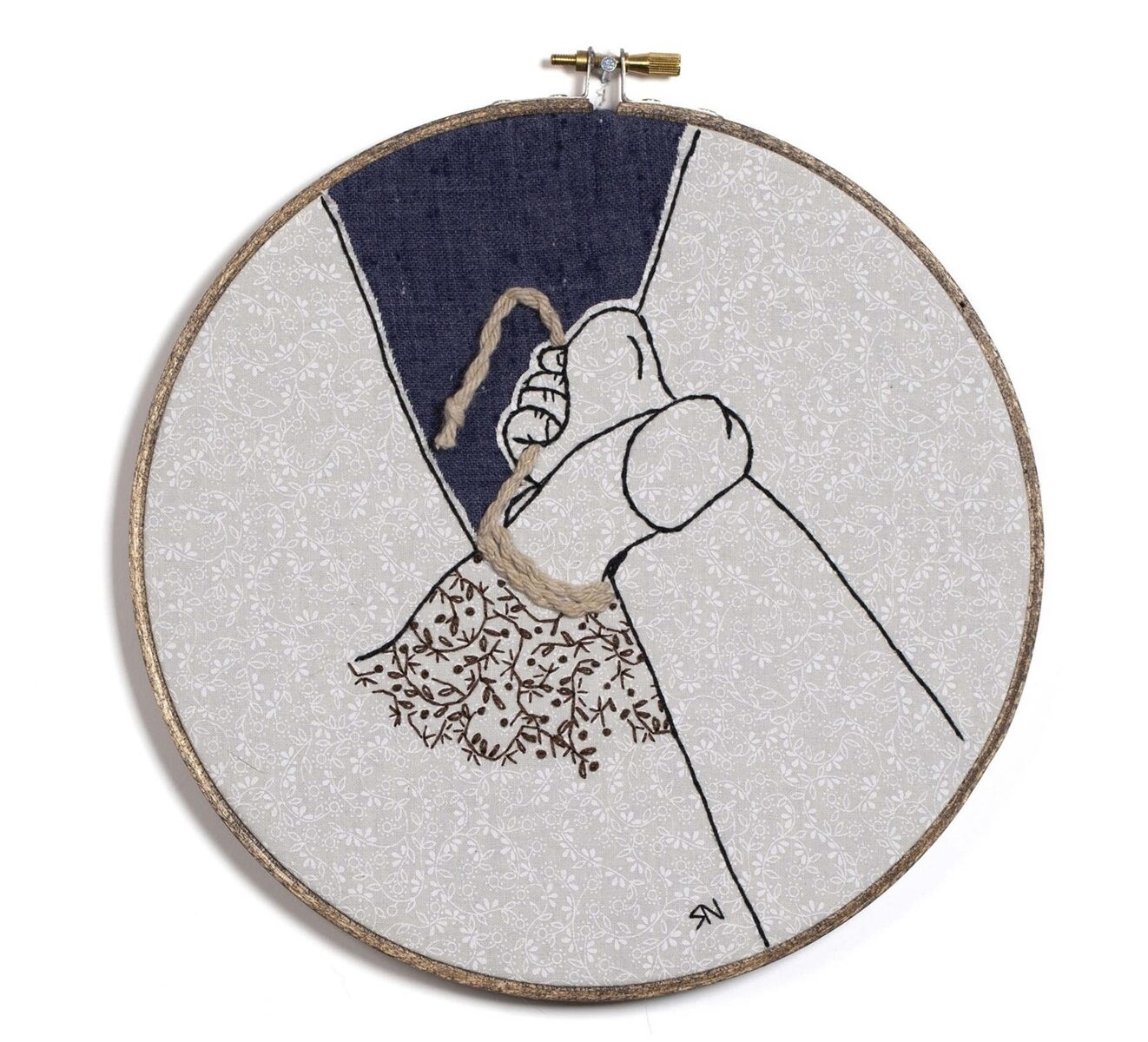

Yank, 8-Inch Hoop, Vintage Cotton Fabric, Embroidery Floss, Yarn, and Hand Embroidery, Steffie Notion, 12 Inches of Sin VIII
We are so glad you like this piece. We do, too! Please complete this form so that we may connect you with the artist. We hope you decide to add this beautiful work of art to your collection.
Art Inquiry
THE EROTICS OF PRESSURE: POWER, PULL, AND THE BODY IN TENSION — YANK
8-INCH HOOP, VINTAGE COTTON FABRIC, EMBROIDERY FLOSS, YARN, AND HAND EMBROIDERY
THE BODY AT THE POINT OF PRESSURE
Steffie Notion locates the erotic not in display but in force. In Yank, a single embroidered hand pulls with deliberate insistence, its gesture arrested at the precise moment where action becomes sensation.
Threads tighten. Fabric resists. What we witness is not merely an image of touch, but an image of pressure made visible—pressure as effort, as friction, as embodied intent.
This is intimacy rendered through strain. The body is encountered not at rest, but at the limit of its own exertion. The tension does not resolve into release. It holds. The hand does not complete its task. It remains suspended in the charged interval between impulse and consequence. In this suspension, eroticism emerges not as spectacle, but as proprioceptive awareness: the felt knowledge of a body acting upon itself.
Notion’s work rejects softness as the default language of desire. Here, desire is muscular. It is authored through pull, through resistance, through the visible labor of contact. The erotic body is not offered to the viewer. It establishes itself through pressure. And it is precisely through the slow, tactile accumulation of thread, fabric, and stitch that this force is made legible—carrying us directly into the material language through which Yank is constructed.
EMBROIDERY AS TACTILE ASSERTION
Notion treats embroidery as an act of embodied labor rather than surface embellishment. Each stitch carries time, pressure, and deliberate repetition, transforming thread into a tactile record of force exerted on and by the body. The material resists speed and immediacy, insisting instead on endurance, restraint, and physical commitment. In this way, the surface becomes a site of negotiation, where intimacy is built slowly through accumulation rather than exposure.
The act of stitching asserts presence through restriction. Movement is limited, progress incremental, and error irreversible. These constraints are not incidental; they are integral to the work’s meaning. Embroidery becomes a method through which care and control coexist, binding vulnerability to agency. The body is not illustrated but felt, registered through the rhythm of labor and the weight of repetition.
In this regard, her practice aligns with Louise Bourgeois’s textile works, where stitch and fabric operate as instruments of psychological pressure, memory, and embodied tension rather than decoration. Like Bourgeois, Notion uses softness not as comfort, but as resistance— deploying textile materials to confront the quiet forces that shape intimacy, obligation, and self-containment.
The result is a visual language grounded in touch rather than spectacle. Thread becomes evidence of presence, and labor becomes a form of assertion. What emerges is not ornament, but a disciplined intimacy— one that refuses passive consumption and instead insists on careful, sustained engagement.
THE HAND AS AGENT OF POWER
In Yank, the hand is the central protagonist. It does not caress. It directs. Yet its authority is not extracted from domination alone. It emerges through relation—between grip and ring, between tension and response, between intention and resistance. The power here is not unilateral.
EROTICISM WITHOUT IDEALIZATION
The stitched body in Yank is not polished into fantasy. The torso is simplified but not sanitized. The lines of the chest, the distribution of texture, the interruption of grid and cloth refuse the smoothness of commercial erotic imagery. This is not a body offered for consumption. It is a body engaged in experience.
Notion’s commitment to body positivity is not illustrative—it is structural. The work does not ask whether this body is “desirable” by dominant standards. It assumes desire as a given and builds outward from there. The erotic here is not earned through conformity. It is declared through presence.
This positions Yank in direct opposition to visual regimes that demand perfection as a prerequisite for pleasure. Notion does not correct the body. They empower it. It is from this refusal of correction that the work’s deeper declaration emerges.
THE HAND AS DECLARATION
In Yank, the hand does not perform for an external gaze—it declares presence. The pull is intimate, yes, but it is also self-directed. What is stitched is not a fantasy of control imposed from above, but a moment of choosing pressure, choosing tension, choosing sensation. The body is not displayed for approval. It is engaged in its own experience.
Notion’s embroidery does not polish the body into perfection. It affirms it through labor. Every stitch insists that this body is worthy of time, touch, and attention exactly as it is. The harness ring becomes neither threat nor ornament alone, but a site of intention—where desire is held, examined, and claimed.
Rather than dramatizing power, Yank normalizes it as embodied authorship. The work does not shout its politics. It lives them—quietly, insistently, and without apology. In this way, Notion offers not a spectacle of empowerment, but a sustained image of self-possession, where pleasure is not granted by an outside force, but generated from within the body itself.
Enjoy the 12 Inches of Sin VIII Art Catalog here!