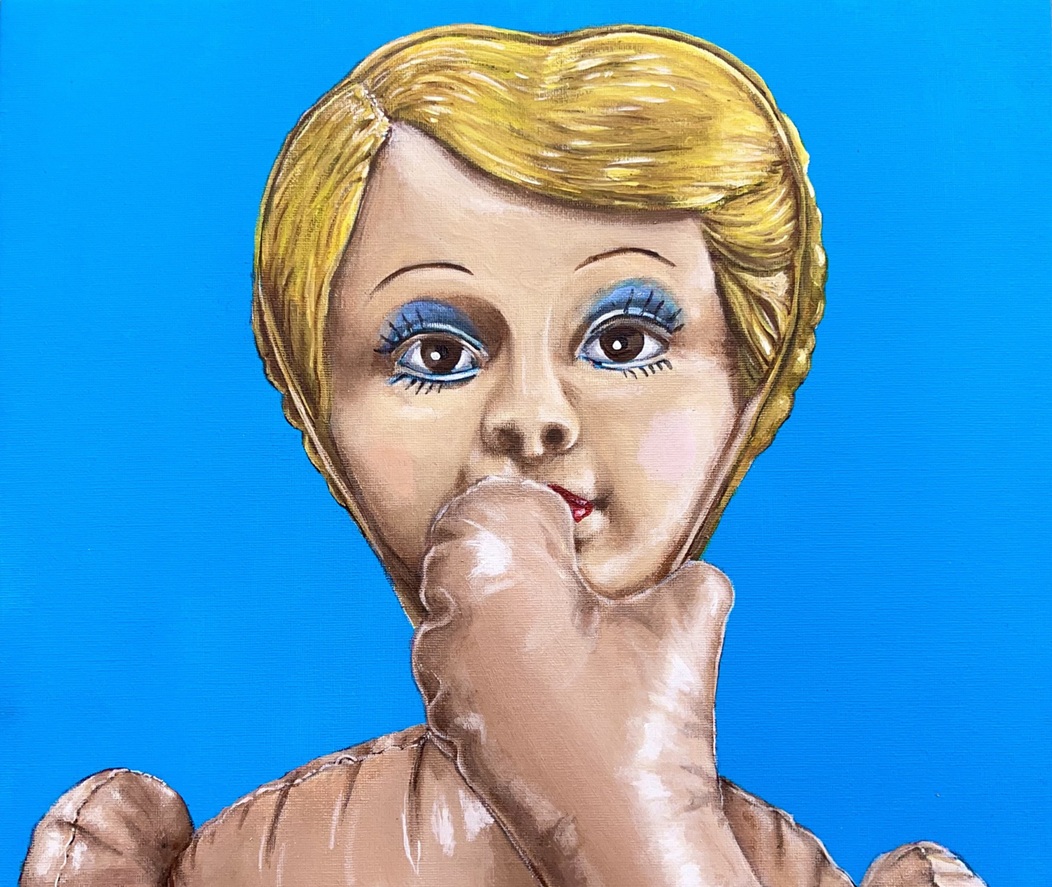

The Inner Garden, Oil on Canvas, Arturo Garcia, 12 Inches of Sin VIII
We are so glad you like this piece. We do, too! Please complete this form so that we may connect you with the artist. We hope you decide to add this beautiful work of art to your collection.
Art Inquiry
THE BODY AS SANCTUARY: THE INNER GARDEN
OIL ON CANVAS
A FIGURE HELD WITHIN COLOR AND SILENCE
In The Inner Garden, Arturo Garcia presents the human body not as spectacle, but as a self-contained universe. The circular, mandala-like composition encloses a nude figure drawn inward, knees tucked to chest, arms protective yet unstrained. The figure hovers within concentric rings of turquoise, rose, and crimson—a chromatic architecture that feels playful and meditative. Small blossoms drift across the surface like quiet witnesses.
The posture is neither defensive nor performative. It is contemplative. The body curves inward not in retreat, but in gathering. There is no outward drama here. Instead, Garcia offers stillness as an erotic posture and vulnerability as an autonomous state of power. This is not the nude for the viewer. It is the nude for itself.
THE EROTIC WITHOUT THE GAZE
What distinguishes The Inner Garden from traditional erotic figuration is its refusal of voyeurism. The figure does not invite attention, nor resist it. It simply exists. The erotic is held internally, circulating within the sealed geometry of the painting.
The concentric rings operate as psychological thresholds—boundaries the viewer cannot cross. Blossoms read as symbols of emergence and delicate vitality blooming within containment. Desire is not consumption here. It is cultivation. Garcia reframes the erotic as a sovereign interior state, reclaiming it from spectacle and returning it to autonomy.
WHEN OIL PAINT BECOMES ATMOSPHERE
Garcia’s oil technique is precise yet intimate. The surface alternates between velvet-smooth skin tones and softly vibrating color fields. Light does not strike from without; it seems to rise from beneath the skin, giving the body a quiet, psychological luminosity.
No transitions are hard-edged. Every boundary breathes. The flesh is rendered with realism, yet the surrounding space dissolves into stylized abstraction. Stillness becomes generative, a living pause where sensation gathers meaning.
BETWEEN SANCTUARY AND SYMBOL
The circular structure evokes spiritual iconography, alchemical diagrams, and cosmological maps. The body becomes the temple. The inner life becomes sacred geography. Blossoms echo fertility, transformation, impermanence.
Yet the mood remains profoundly human. The figure’s gaze is steady and unsentimental. This is not an archetype. It is a person who has
claimed interior quiet as sovereignty. This is where the subject’s aura seduces the viewer.
THE BICULTURAL LINEAGE BENEATH THE SURFACE
Born in Mexico and working in the United States,, Garcia carries a bicultural visual language that quietly informs The Inner Garden. Symbolic geometry, ritualized stillness, and nature-based metaphor reflect a dialogue between Mexican cosmology, European modernism, and surrealist introspection.
His work often navigates thresholds: abstraction and figuration, myth and body, vulnerability and resilience. The immigrant experience appears here not as narrative but as psychological architecture.
EROTICISM AS SURVIVAL, NOT PERFORMANCE
For Garcia, the erotic is not commodity but vitality. It signals presence and the irreducible mystery of embodiment. In The Inner Garden eroticism functions as respiration rather than offering. This work does not ask to be consumed. It asks to be recognized.
THE GARDEN AS INTERIOR TERRITORY
Ultimately, The Inner Garden is a meditation on self-possession. The body rests not in shame or display, but in quiet authority. Blossoms linger. Colors hold. Stillness becomes its own form of strength.
Garcia grants the viewer permission to witness a rare state: erotic stillness without extraction.
The garden is not outside us. It is what we protect within.
As contemporary figurative painting undergoes a global renaissance, Garcia’s work offers a necessary countercurrent—one rooted not in display, but in interior sovereignty. His paintings reject the spectacle of exposure and instead cultivate a world where the body belongs wholly to itself. In the end, Garcia reminds us that the figure is not revealed through what it shows, but through what it refuses to surrender.
Enjoy the 12 Inches of Sin VIII Art Catalog here!