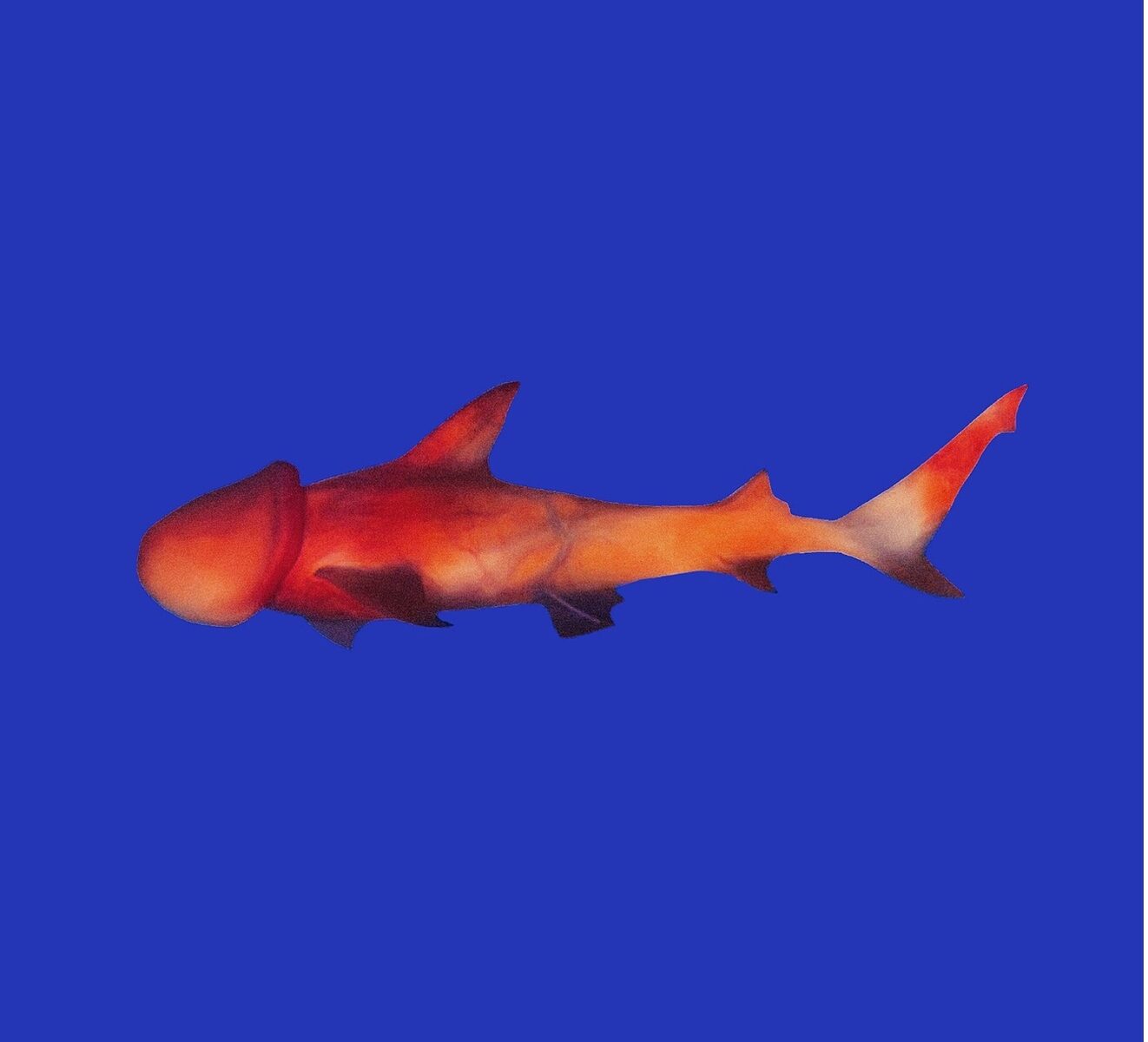

Master Bait, Digital Illustration, Christoper Labine, Jr. (DICKSOVERIES), 12 Inches of Sin, Le Salon des Refusés Péché
We are so glad you like this piece. We do, too! Please complete this form so that we may connect you with the artist. We hope you decide to add this beautiful work of art to your collection.
Art Inquiry
THE ANATOMY OF THE DOUBLE ENTENDRE: MASTER BAIT | BEST IN SHOW
FROM THE LOCK JAWS SERIES
DIGITAL ILLUSTRATION
SATIRE AS SIGNAL: THE VISUAL LANGUAGE OF DICKSCOVERIES
Working under the moniker DICKSCOVERIES, Christopher Labine, Jr. builds images that seduce through surface and destabilize through implication. His visual world hums with saturated color, queer provocation, and an electric tension between exposure and concealment. In Master Bait, that tension crystallizes with immediate clarity. Against a saturated blue field, a hammerhead shark glides laterally across the surface in luminous reds and oranges. At first glance, the image reads as playful, even cartoonish. On closer inspection, the creature’s head unmistakably doubles as a phallus—an absurd hybrid that is both comical and jarring. The punning title drives the point home, setting the stage for a work that thrives on double meaning and visual innuendo.
What initially operates as a visual joke quickly reveals itself as strategic misdirection. Sharks, apex predators associated with fear and dominance, are here stripped of menace and re-scripted through parody. The predator becomes bait. The threat becomes invitation.
Power is displaced into spectacle, control into suspended motion. In this reversal, Labine does not simply cartoon the phallus. He destabilizes the visual language of dominance itself.
SOUTHERN MYTH, QUEER CODING, AND THE POLITICS OF PLAY
Raised within a culturally conservative environment structured by restraint and expectation, yet shaped by a family with deep ties to the arts, creative entrepreneurship, and a culture of exploration, Labine developed a visual language attuned to pressure, contradiction, and coded visibility. That dual foundation—of limitation and possibility— coexists in his work with a sustained interrogation of power, vulnerability, and queer identity. Figures associated with masculinity and authority recur throughout his practice not as fixed archetypes, but as unstable sites of psychological tension. Across bodies of work such as Outlaws in Love, Ghosted, and Lock Jaws, identity is repeatedly stripped of heroic certainty and repositioned within fragile, erotic, and emotionally charged states. These series trace the longer psychological arc of that negotiation across time, while Master Bait functions as a concentrated rupture—compressing those tensions into a single image of calibrated humor, exposure, and control.
In Master Bait, that mythology does not arrive as costume or narrative, but as structure. The shark becomes its own hybrid outlaw, a predator stripped of natural habitat and staged instead as spectacle. Humor operates here as both shield and weapon. Labine has described vulnerability as the engine of his work and control as its structure—a dual logic visible in the image’s careful restraint. The joke is immediate, but not casual. It is calibrated. Early experiences with censorship and rejection did not soften his sensibility; they clarified it. Master Bait emerges from that lineage of risk—a work that refuses comfort even as it invites laughter. Play does not neutralize power here. It exposes it.
SURFACE, SATURATION, AND THE DIGITAL PUNCHLINE
Formally, Master Bait demonstrates tight discipline beneath its visual exuberance. The composition is stripped of narrative distraction. There is no environmental context to soften impact, no horizon line to offer escape. The shark floats within a compressed chromatic field, suspended in a visual space that feels both infinite and claustrophobic. The saturated blue does not signify oceanic realism. It functions as theatrical ground. A stage.
The warm gradient of the shark’s body—shifting from deep red through amber into pale coral—heightens the sense of fleshy artificiality. The surface reads as digital skin: smooth, hyper-real, and slightly unreal. The creature does not advance. It drifts. This suspension destabilizes the expected aggression of both predator and phallic symbol. Power is present but held in suspension. The tension emerges not through chase, but through anticipation.
The restraint is critical. The work does not overwhelm through excess detail. It concentrates force through clarity. This precision echoes how queer bodies are often pulled into visibility through mechanisms of spectacle—how desire becomes both permission and exposure. To look is already to participate. To laugh is already to be implicated. The work does not scold the viewer for that participation. It structures it.
MALENESS, POWER, AND THE REVERSED PHALLUS
Master Bait also stages a confrontation with maleness itself—not only queer masculinity, but masculinity as a historical engine of dominance. In a patriarchal visual economy, the phallus has long functioned as a symbol of authority, conquest, possession, and control. Here, that symbol is neither concealed nor exalted in the traditional sense. It is abstracted, exposed, hybridized, and ultimately aestheticized. By fusing the phallus with an apex predator—an icon of instinctual power—Labine collapses the logic of domination into a form that is no longer sovereign but observable. What once commanded the gaze is now subjected to it. The phallus becomes not the force that orders the world, but an image to be looked at, desired, objectified, and stewarded. In this reversal, power is neither erased nor celebrated—it is redistributed through visibility.
DOUBLED VISION: PREDATOR, PREY, AND THE QUEER GAZE
The psychic engine of Master Bait rests in doubleness. The same form reads simultaneously as threat and invitation, as joke and weapon, as seduction and critique. This doubleness mirrors the queer condition under public optics: hyper-visible yet perpetually coded, celebrated and policed at once. The image refuses emotional resolution. It does not allow the viewer to stabilize into singular response—arousal, amusement, discomfort, or complicity. Instead, it forces those reactions
to coexist. This instability is not aesthetic accident. It is the work’s political architecture. Here, the gaze is not neutral. It is activated, tested, and folded back onto itself.
IDENTITY, BODY, AND DEFIANCE AS METHOD
Labine’s broader practice consistently positions eroticism not as private fantasy but as public risk. Shaped by early encounters with shame, censorship, and the pressure to sanitize queerness within conservative cultural environments, he treats vulnerability as engine and control as structure. Risk is not accidental. It is method.
Master Bait extends this logic with precision. The body, even in its abstracted, cartooned form, is never neutral. It is a sign under negotiation—desired, disciplined, commodified, and surveilled. The image refuses to resolve those conditions into comfort. Pleasure is not presented as escapist but as a diagnostic tool. The quick laugh, the uneasy pause, the compulsion to look again—these responses become part of the work’s architecture. Provocation operates here not as shock tactic but as analytic instrument, measuring where tolerance fractures and where curiosity reasserts itself.
PROVOCATION AS MEASURE OF SUCCESS
These reactions become structural forces within the work, tracing the fragile boundary where tolerance fractures and curiosity reasserts itself. Meaning flickers precisely in that instability, where perception is forced to choose and refuses to settle.
The viewer is compelled to decide whether the work is satire, pornography, critique, or spectacle. The refusal to settle into a single category is precisely where the work activates. Classification becomes the site of friction. In this sense, Master Bait does not merely provoke sensation. It provokes interpretation—and then destabilizes it.
QUEER LINEAGE WITHOUT IMITATION
Although the work operates in dialogue with historic queer visual cultures, it does not repeat those genealogies. It metabolizes them. The exaggerated masculinity becomes less about dominance than exposure. The form appears powerful, but it is also theatrically vulnerable.
Rather than rebuilding queer nostalgia as fantasy refuge, Master Bait interrogates the machinery that produced it. What once functioned as coded survival now reappears as open signal.
CONTEMPORARY QUEER ILLUSTRATION AND THE ARCHITECTURE OF SATIRE
While Master Bait carries clear genealogical echoes of Tom of Finland’s hypermasculine archetypes, its relationship to power operates along a different axis. Where Tom of Finland constructed erotic fantasy as liberated amplification, Labine redirects amplification into critique. Strength becomes vulnerability. Exposure becomes interrogation.
At the level of formal economy, the work also enters quiet conversation with the visual restraint of David Hockney, particularly in its use of flat chromatic fields, simplified spatial logic, and the psychological charge of saturated color. Like Hockney, Labine demonstrates that visual clarity can carry emotional complexity without symbolic overload.
This fusion—erotic archetype, digital surface, and satirical compression—places Master Bait squarely within the current generation of queer illustrators who deploy humor not as escape from politics, but as one of its most precise instruments.
FROM FIRST PROVOCATION TO INSTITUTIONAL RETURN
Labine’s early emergence through underground markets, festivals, and independent exhibitions established a practice rooted in immediacy and confrontation. His early appearance in 12 Inches of Sin as one of the youngest finalists marked a moment where insurgent eroticism crossed into curated space without dilution. Over the years, that early defiance evolves. The return with Master Bait does not read as nostalgia. This trajectory—from zine culture to institutional wall—does not signal assimilation. It signals endurance.
BEST IN SHOW: WHY THIS WORK, NOW
Master Bait was selected for Best in Show for its exceptional synthesis of visual restraint, erotic satire, and political intelligence. Through formal precision and conceptual clarity, the work transforms humor into a sharp instrument of critique. Labine’s image disarms the viewer through play while simultaneously exposing the structures of desire, spectacle, and power that govern contemporary queer visibility. At once seductive, confrontational, and exacting, Master Bait exemplifies the highest level of contemporary queer illustration.
To recognize Master Bait as Best in Show at Le Salon des Refusés Péché is to acknowledge more than its immediate visual audacity. It is to recognize satire as one of the sharpest instruments of contemporary queer liberation. At a moment when queer bodies are simultaneously commodified, legislated, celebrated, and surveilled, Labine’s work refuses the comfort of singular interpretation.
The image entertains. It also indicts. It invites the viewer into pleasure. It also exposes the structure that governs that pleasure. Humor does not dissolve politics. It sharpens it. Master Bait functions not as comic relief from power but as its mirror. The work sustains contradiction without collapsing into cruelty or retreating into softness. It remains playful, dangerous, and exacting all at once. This piece affirms queer satire as one of the most potent forms of truth-telling—not through volume, but through disarmament and sustained pressure.
Enjoy the 12 Inches of Sin VIII Art Catalog here!