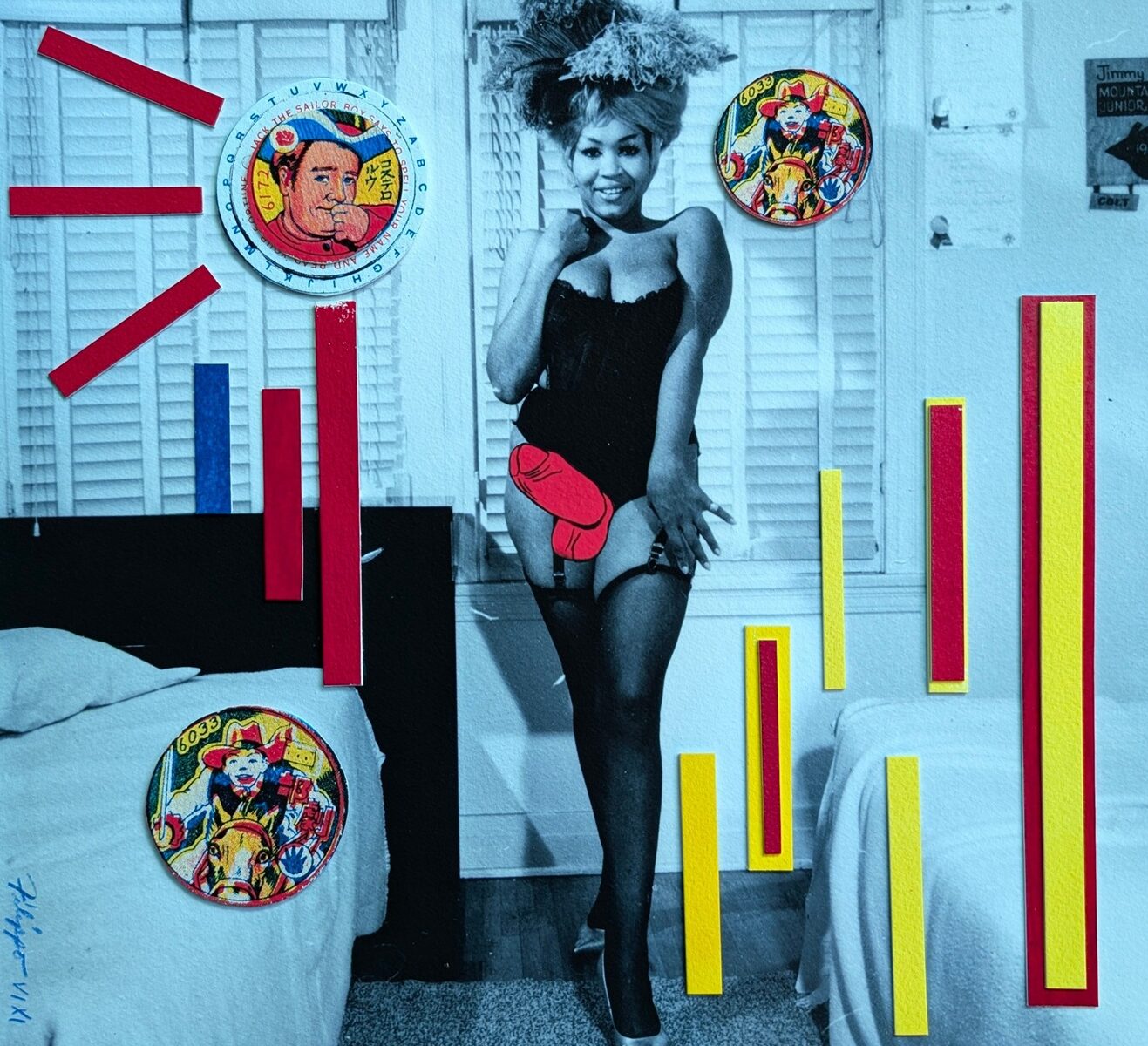

La Nouvelle, Mixed Media Collage on Paper, Nicola Filippo, 12 Inches of Sin VIII, Le Salon des Refusés Péché
We are so glad you like this piece. We do, too! Please complete this form so that we may connect you with the artist. We hope you decide to add this beautiful work of art to your collection.
Art Inquiry
THE ARCHITECTURE OF COLLAGE AND THE PERFORMANCE OF LOOKING: LA NOUVELLE
Mixed Media Collage on Paper
THE EROTIC REORIENTED
What seems private is already public.
The title itself carries a subtle provocation. La Nouvelle, by Nicola Filippo suggests both “the new” and “the narrative,” positioning the work as a rewriting of erotic symbolism rather than a reiteration of it. The body is not offered as passive subject. It is framed as an active participant in the choreography of looking. The result is not nostalgia. It is reorientation.
This is the central tension of the practice: eroticism that refuses to collapse into solemn sensuality or cheap spectacle. The body is fully present, yet constantly disrupted by signs, structures, and coded interruptions. Intimacy is visible, but never isolated. What emerges is not an image of sex alone, but a meditation on how desire is staged and consumed in public culture.
DESIRE AS STAGECRAFT
The authority of La Nouvelle lies in its refusal of subtlety as camouflage. Erotic imagery is not softened into tasteful ambiguity. It is amplified.
Bold graphic bars climb the walls like visual meter readings. Emblems hover like targets or trophies. The bedroom becomes a proscenium. Desire does not whisper here. It performs.
This exaggeration is not decorative—it is conceptual. By pushing the symbols of erotic culture into near-caricature, the work exposes how mass culture already scripts the body for consumption. The image becomes a mirror of spectacle itself, forcing awareness of the systems that accompany pleasure. Eroticism is not reduced through irony. It is intensified through excess. The performance is the point.
COLLAGE AS TRANSLATION
The material language of collage is essential to the conceptual function of the work. Photographic realism is interrupted by flat graphic inserts, archival fragments, and emblematic forms that refuse seamless integration. These visual disruptions do not decorate the image—they translate it. Each interruption reframes the body as a site where media, memory, spectacle, and desire collide. The figure remains visible, but her authority is perpetually renegotiated through layers of signs, symbols, and interruptions.
In this way, collage becomes both method and metaphor. Desire does not move in a straight line here—it is rerouted, deferred, and refracted through cultural noise. The body is not consumed as image alone but encountered as a contested surface shaped by competing visual languages. What appears as excess is, in fact, structure. What appears as chaos is choreography. The process itself is tactile and meditative. Paper, pigment, ink, texture, and glue build meaning through physical labor. The humor, the timing, the interruptions all arrive through touch. This is not digital slickness masquerading as collage. It is construction. Desire is not discovered here—it is assembled by hand.
LICENTIOUSNESS AND LEGITIMACY
Formally trained at Otis College of Art & Design and California College of the Arts, Filippo brings the discipline of institutional art foundations into direct dialogue with the unruly lineage of underground erotica. His influences include the conceptual and collage strategies of Ray Johnson, whose approach to fragmentation and symbolic humor resonates through Filippo’s own tactile constructions. With exhibitions across the United States and Europe, his work maintains an international presence that underscores the global relevance of erotic image cultures.
Within this tension—between academic training and transgressive play—Filippo’s compositions oscillate between the aesthetics of underground zines and the precision of formal craft, generating a friction that refuses stability. Nothing settles into comfort because the artist has never worked from comfort—only from the charged space between permission and refusal.
EROTICISM WITHOUT RESPECTABILITY
In a culture that routinely suppresses sexual imagery while celebrating violence, La Nouvelle refuses the demand for respectability. Its eroticism is not apologetic. It is not coded into abstraction for safety. It is bold, humorous, and self-aware. This refusal aligns the work with contemporary erotic discourse where provocation is not novelty—it is language. Eroticism is not framed as commodity. It is framed as social performance—messy, theatrical, contradictory, and alive.
DESIRE AS PERFORMANCE, NOT PRODUCT
La Nouvelle refuses to define eroticism as something to be owned or consumed. It frames desire as something enacted—more theatrical than transactional—shifting between humor and power, spectacle and agency, invitation and interruption. By exaggerating form, staging humor, and fragmenting surface, the work restores consequence to looking. The viewer does not leave with possession, but with awareness—of their gaze, their appetite, and their role in the choreography of image and desire. In this way, La Nouvelle does not merely depict erotic power. It redistributes it through performance.
In dialogue with Hannah Höch and Pierre Molinier—each revealing the body as a site of fragmentation and erotic performance—Filippo advances this lineage with contemporary urgency. His work shows that erotic imagery is not simply seen but constructed through inheritance, disruption, and desire. La Nouvelle makes clear that looking is never passive but an exchange shaped by power, memory, and imagination.
Enjoy the 12 Inches of Sin VIII Art Catalog here!