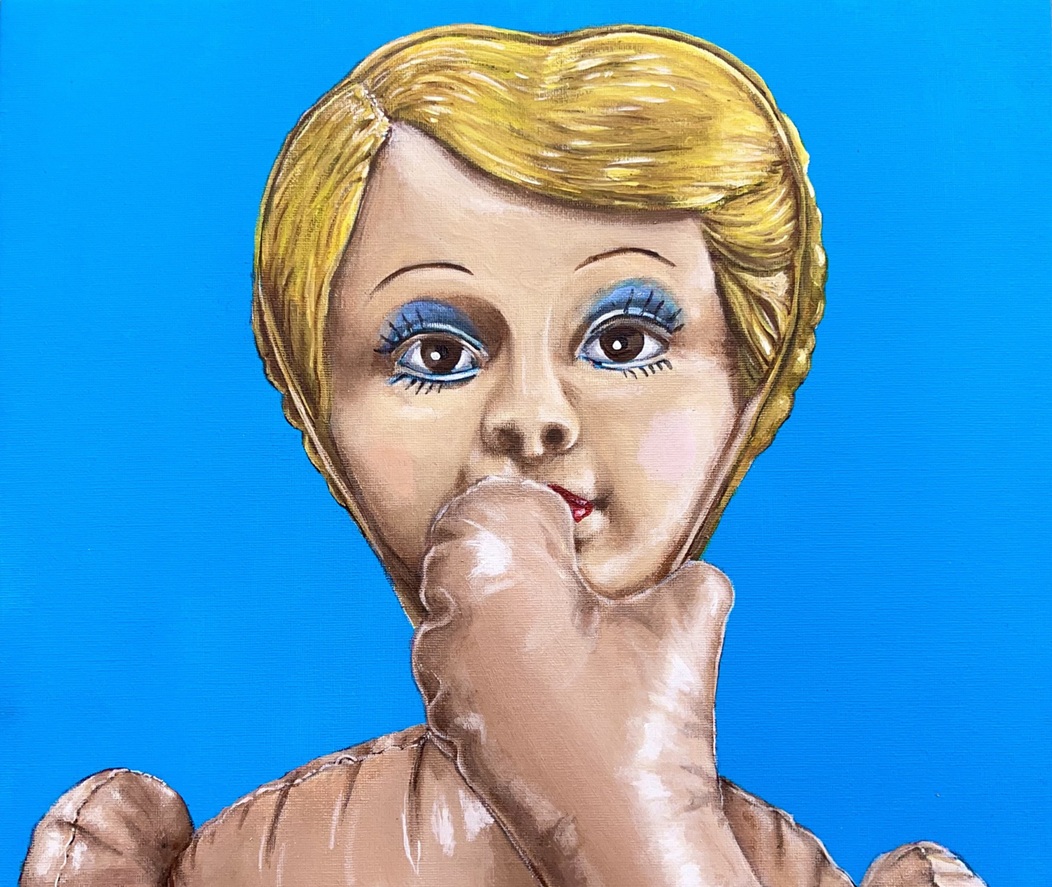
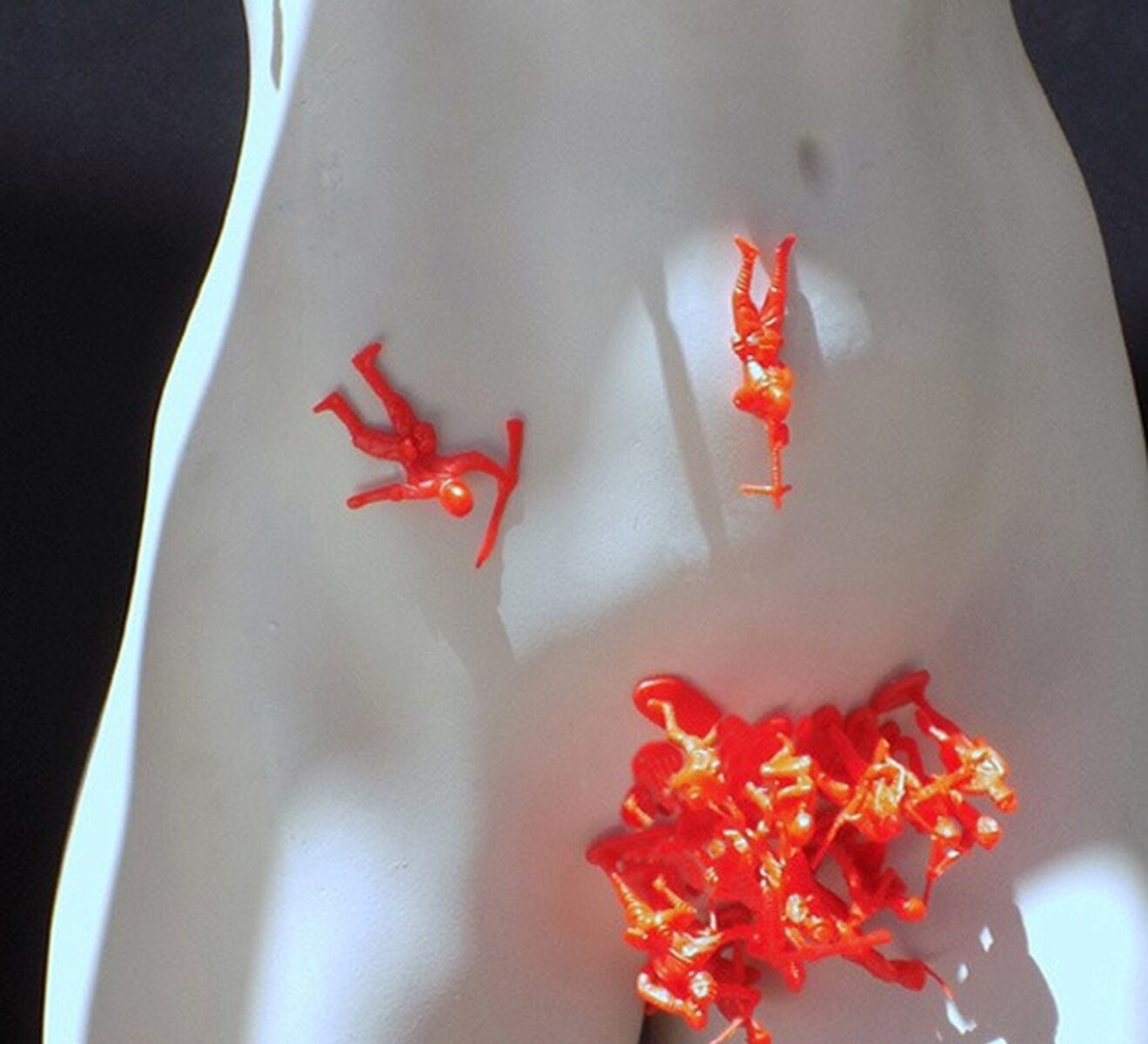

Body Snatchers #16, Digital Photograph, Diane Bush, 12 Inches of Sin VIII
We are so glad you like this piece. We do, too! Please complete this form so that we may connect you with the artist. We hope you decide to add this beautiful work of art to your collection.
Art Inquiry
DIGITIZED DISSENT IN A POST-ROE WORLD: BODY SNATCHERS #16
DIGITAL PHOTOGRAPH
A LEGACY OF SUBVERSIVE SEEING
For over five decades, Diane Bush has wielded photography as both shield and sword—protecting human dignity while confronting the political machinery that seeks to erode it. A long-recognized activist artist whose work resides in the permanent collections of the Museum of Modern Art and the Tate, and a recipient of a Nevada Arts Council Fellowship, Bush’s career has unfolded across the UK, Buffalo, and Las Vegas in direct response to the shifting political climates of each terrain. Across five decades, her practice has remained both formally restless and politically unflinching—continually experimenting across analog, digital, and hybrid processes as tools of resistance. Body Snatchers #16, a searing entry in her long-standing practice of socially engaged art, continues this lineage with unrelenting urgency. The digital photograph stands at the intersection of feminist critique, media distortion, and bodily autonomy—rendering the human form not as portrait, but as battleground.
DISINTEGRATION OF THE FIGURE
The subject of Body Snatchers #16 is a woman, though barely recognizable as such. Her figure, intercepted by harsh lines and chromatic distortions, is fragmented—visually violated—by the very digital tools used to capture her. Bush manipulates color, shadow, and glitch to obliterate any possibility of serenity. Instead, the viewer is met with a warped, partially pixelated being—dismembered not by violence of flesh, but by the violence of context. Jagged overlays interrupt the soft contours of the body, as if state control, social erasure, and algorithmic bias were seeping into the image itself, rewriting her presence frame by frame.
The figure is not merely disrupted—it is contested. The digital interventions do not decorate the form; they invade it. The body is no longer a site of presence alone, but a surface onto which systems of power project their authority, rendering her both visible and endangered within the same breath.
CINEMATIC REFERENCE AND CONTEMPORARY PARANOIA
The title references the 1956 and 1978 films Invasion of the Body Snatchers, both cautionary tales about conformity and paranoia. Yet here, Bush radicalizes the metaphor. The body being “snatched” is not taken by aliens, but by legislation, ideology, surveillance, and algorithmic governance. Her digital manipulations echo thermal imaging, biometric capture, and forensic scanning—recasting the camera as an instrument not of witness, but of occupation.
The figure becomes data. Flesh becomes evidence. Identity dissolves into measurable threat. In this reframing, Bush exposes the technological gaze as inseparable from the political one.
SURVEILLANCE, CENSORSHIP, AND THE POST-TRUTH BODY
Bush’s photographic language draws directly from the aesthetics of control. Digital overlays evoke facial-recognition systems, medical imaging, and propaganda graphics. Geometric interruptions slice organic lines, imposing a technological grid over tissue. The tension is not merely formal—it is psychological. In a post-Roe America, where autonomy is legislated and monitored, this work refuses subtlety.
Shadows along the torso and thighs signal more than erasure; they signify tracking. Light becomes interrogation. Visibility becomes vulnerability. The body is no longer private—it is processed.
FEMINIST INTERVENTION THROUGH THE PIXEL
Bush’s visual activism did not begin with digital tools, but they have sharpened its precision. Her early analog work challenged the sanitized media narratives of the Reagan era. Her satirical manipulations of political figures earned international visibility. In Body Snatchers #16, this activist lineage mutates into pixel-based disruption. Here, glitch becomes testimony. Distortion becomes protest. The image does not merely document injustice—it performs it.
Bush has explicitly described the work as staging two opposing forces fighting for control over a woman’s body—specifically her sexuality and reproductive autonomy. That conflict is not illustrated symbolically. It is enacted structurally. The body itself becomes the site of struggle, distortion, seizure, and resistance simultaneously.
THE BODY AS CONTESTED TERRITORY
Body Snatchers #16 is a visual alarm, piercing in both form and content. By obscuring the body, Bush paradoxically reveals the systems that seek to control it. This is not a portrait of a woman. It is a portrait of what the world does to women’s bodies—and what artists like Bush do in return. She frames the digital image as both subject and site of resistance, inviting us to witness and question the invisible mechanisms of power.
In the end, Bush’s work does not offer comfort. It offers confrontation. And in doing so, it upholds her legacy as a visual dissenter, a chronicler of contested truths, and a master of photographic resistance—still as bold, nuanced, and necessary as ever.
THE IMAGE AS A POLITICAL ALARM
What distinguishes Bush’s five-decade practice is not longevity alone, but its relentless adaptability. Moving fluidly across analog photography, digital experimentation, satire, documentary strategies, and layered post-production, she treats medium itself as a political choice—one that shifts as power shifts. Body Snatchers #16 stands as a present-tense confrontation: an image that refuses comfort and demands reckoning.
The body appears here as political site, data field, and living territory at once. This is protest photography recalibrated for a post-truth generation—demanding not passive empathy, but recognition. In this insistence, Bush’s legacy endures not as history, but as living resistance.
Enjoy the 12 Inches of Sin VIII Art Catalog here!