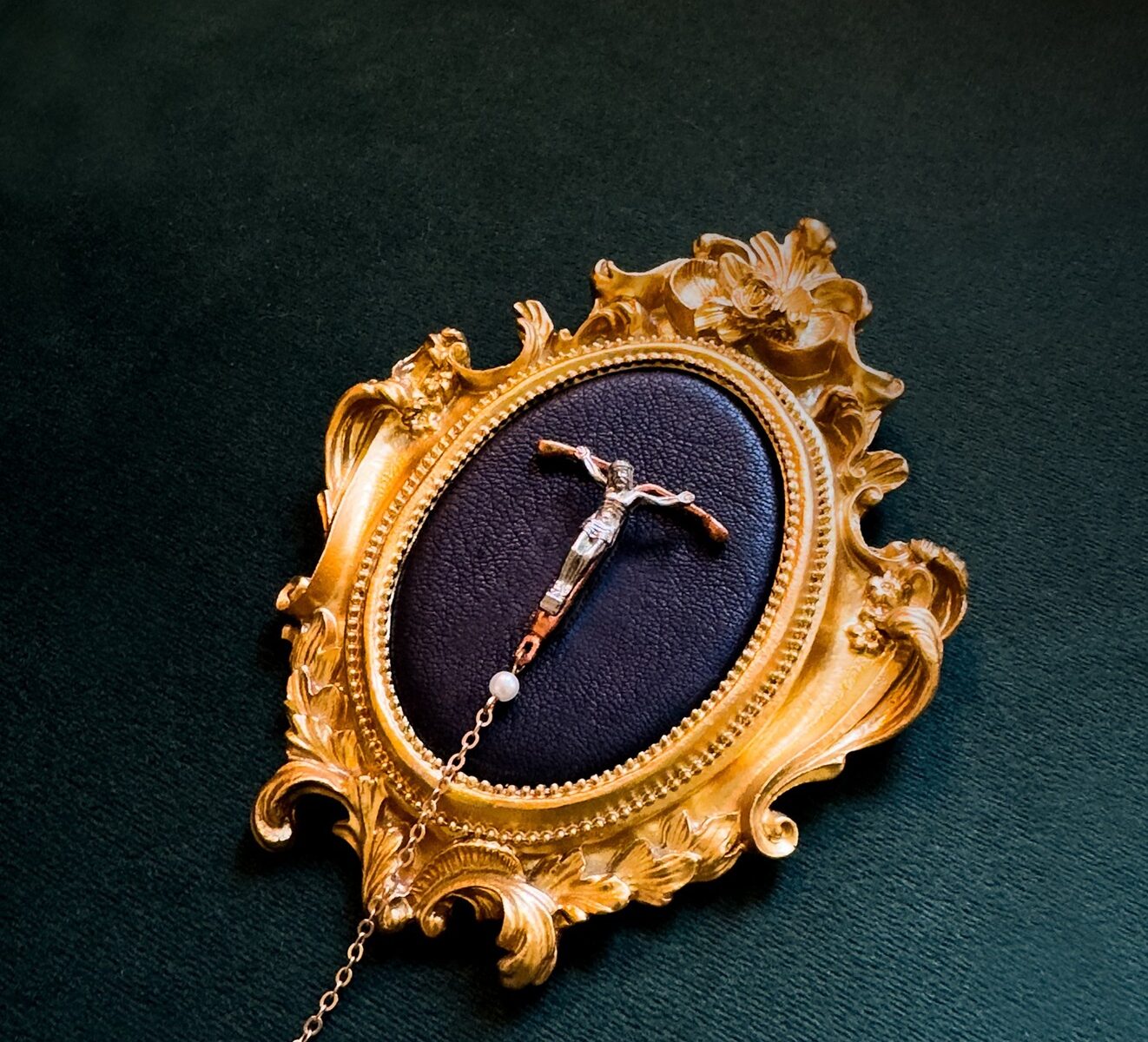

Crux, Christ Figure with Bronzed IUD, Leather, Rosary Chain, and Gold Frame, French 75, 12 Inches of Sin VIII
We are so glad you like this piece. We do, too! Please complete this form so that we may connect you with the artist. We hope you decide to add this beautiful work of art to your collection.
Art Inquiry
THE THEOLOGY OF REFUSAL: CRUX | BEST IN SHOW
FROM THE DEAD BAROQUE SERIES
CHRIST FIGURE WITH BRONZED IUD, LEATHER, ROSARY CHAIN, AND GOLD FRAME
DEAD BAROQUE: WHERE ORNAMENT BECOMES WITNESS
French 75’s practice is not the product of a single medium or moment but the culmination of a lifetime of formal exploration and reinvention. Based in San Francisco, they work as a mixed media artist, graphic designer, creative director, stylist, and self-described lover of beauty—roles that converge into the layered visual intelligence of their ongoing body of work titled Dead Baroque. With an MFA in Graphic Design, their understanding of structure, composition, visual hierarchy, and symbolic economy is precise and disciplined. Yet this training exists alongside a lifelong commitment to making: as a child they painted and wrote lyrical poetry; as a teen they produced punk zines and cut-paper collages; in their twenties they worked with stained glass and sculptural materials; in their thirties they moved into photographic art direction and fashion styling while building a design career. Now, in their forties, these disciplines fuse into the ornate sculptural collage language that defines Dead Baroque. Nothing in this work is casual. Nothing is decorative by accident. Everything arrives through accumulation, refinement, and purpose.
Crux, as presented in 12 Inches of Sin VIII, emerges from an investigation of religion, power, sexuality, bodily autonomy, and resistance. The work does not seek to soften discomfort. It embraces it, weaponizing beauty against submission. Crux addresses the moral governance of reproductive bodies: the punitive medical structures imposed on choice, the ways bodies capable of reproduction are scrutinized and disciplined. It is a work about crucifixion as social condition and birth control as fragile salvation.
Formally, Crux is constructed from a Christ figure and a bronzed IUD, framed on black leather and tethered with a rosary chain. The darkened surface allows the suspended figure to appear weightless, floating rather than nailed. This chromatic density destabilizes the hierarchy between relic and medical device. The IUD is no longer subordinate to the cross. It becomes its theological equal. Ornament is not applied. It is activated. The materials do not coexist politely. They collide.
French 75’s materials remain consistent across their practice: ornate frames, religious artifacts, plaster castings, elements of nature, meaningful collected objects, chains, rhinestones, embellishments, leather, metal leaf, and, as noted plainly, “a lot of glue.” But the material list alone does not explain the work. Each element is chosen because it is thematic, because it advances the intention of the piece. Everything is on purpose.
Crux holds the physical remains of a collaborator’s medical history. Even when the narrative is not directly autobiographical, the piece contains fragments that belong to relationships and communities that shaped it.
The themes orbit pain and anger, sexuality and autonomy, Catholicism and queerness, ferocious vulnerability and ferocious self-possession. These are not opposing forces in the work. They are inseparable.
Queer identity directly informs both the content and posture of the practice. As a gender-expansive queer artist immersed in San Francisco’s intersectional queer community and drag culture, the body is understood not as neutral but as contested. As someone whose body has been subject to consumption, discipline, and control, identity is not abstract. As someone who refuses compliance with hetero-patriarchal expectations, the work does not merely reject those structures. It turns them outward with precision.
The work balances vulnerability and control with exacting clarity. It is vulnerable because it is personal; it offers portions of the self to the audience. But it is never exposed without consent. Risk is not incidental to the process. Everything is an experiment. Some pieces assemble slowly through long sequences of testing. Others, like Crux, arrive suddenly, fully formed. Both modes carry equal authority.
For French 75, success is not measured in visibility alone. It is measured in pride—pride in what is released into the world—and in the recognition that if the work becomes meaningful to even one person, its purpose has already been fulfilled twice. The intent is for the work to be beautiful, engaging, and slightly confrontational. Bold, romantic, perhaps a little uncomfortable. Always deliberate.
This shift reconfigures the logic of the piece. The Christ–IUD hybrid does not descend into suffering. It hovers within sanctified air, occupying the space traditionally reserved for ascent and spiritual approval. Yet what floats here is not redemption. It is regulation. The sky does not save the object. It isolates it.
The effect is destabilizing. A symbol of doctrinal suffering is granted transcendence, while the living bodies governed by doctrine remain grounded in consequence.
Here, reverence itself becomes weaponized.
The Christ figure—miniaturized, metallic—ceases to operate as redeemer and becomes apparatus. The bronzed IUD serves as crossbeam not merely by resemblance but by historical function. Both enter the body. Both regulate pain. Both have been framed as acts of care. Their fusion does not mock faith. It indicts obedience.
In queer life, that operation has rarely been neutral.
The chain binds care to coercion. It sutures love to surveillance. It ties tenderness to endurance.
The work rejects reproductive futurism not by spectacle but by reassignment of sanctity. The IUD is not concealed in shame. It is exalted. The Christ figure is not erased. It is forced to witness what it has historically authorized. In this exchange, queerness becomes not an identity category but a methodology of theological disobedience.
DEAD BAROQUE AND THE POLITICS OF ORNAMENT
Dead Baroque does not resurrect historical ornament. It exhumes it. The ornate gold frame surrounding Crux seduces the eye into reverence and then traps that reverence within contradiction. The frame does not protect the work. It implicates the viewer in its theology.
Baroque aesthetics historically served as propaganda for divine authority and imperial power. Here, that same excess becomes a mechanism of exposure. Ornament no longer glorifies the violence it surrounds. It reveals it.
Institutional control rarely announces itself as brutality. It arrives as tradition, grace, protection, and what is deemed proper. Crux performs this aesthetic logic with precision and then fractures it from the inside.
THE ARTIST’S HAND AS POLITICAL BOUNDARY
That Crux is handmade in San Francisco is not a production detail. It is an ethical threshold. In a cultural economy that automates extraction and distance, French 75 insists on touch. The artist does not outsource meaning. The work bears the compression of decision, consent, and refusal.
This is especially consequential because the work contains a real, extracted IUD. The object once designed to occupy a body is now redirected through the artist’s body. Control moves from institution to individual, from doctrine to dissent. The translation is not symbolic. It is material.
The artist does not reenact violation. The artist redirects its trajectory.
This position is reinforced through ethical sourcing. Elements from nature are cruelty-free. No harm is required to construct the work, even when the work interrogates harm. This refusal to reproduce violence in creation is one of the artist’s quietest and most radical gestures.
NEGATIVE SPACE AS THEOLOGICAL STRATEGY
Negative space here is not decorative. It is tactical. The heavenly blue field isolates the object in suspension rather than grounding it in earth. Nothing distracts from the confrontation between Christ and IUD. Nothing softens the exchange.
Negative space becomes a theological wedge. It pries the sacred away from automatic reverence and returns it to question. Color operates with equal rigor. The palette is staged like argument. The void is deployed like silence after accusation.
This visual interruption prepares the body not for metaphor, but for governance. What appears spiritual must now be read as structural.
Schiaparelli + Drag + Relational Provenance of the IUD
The anatomical surrealism embedded in Crux draws from French 75’s deep relationship to fashion and adornment, particularly the legacy of Schiaparelli’s gilded facial and bodily fragments. That lineage— where the body becomes both sacred and strange—threads directly into their use of gold, ornament, and exalted disfigurement. Just as vital is the drag community that surrounds them: embellished bodies, theatrical excess, unapologetic transformation inform the maximalist detail and sensual defiance of their surfaces.
The IUD itself carries a relational weight often unseen in critical assessments. It was removed from and gifted to French 75 by a dear friend and former collaborator. In this way, Crux is not only a political object but a communal one. Its materials circulate through networks of trust, intimacy, and shared bodily history. The work does not extract meaning from abstraction. It is built from lived exchange.
Best in Show: The Sky That Will Not Redeem You
The black leather allows the figure in Crux to float, but the darkness does not rescue it. Suspended between medicine and martyrdom, between care and coercion, between faith and refusal, the work exists in a permanent state of interruption. It does not argue against belief. It demands accountability for how belief organizes bodies. The body here is not purified through pain. It is liberated through refusal.
Here, the crucifix is not metaphor but infrastructure. Fused with the IUD, the cross no longer governs through salvation but through regulation. Spiritual law hardens into anatomical policy. Devotion reveals itself as governance.
To name Crux Best in Show for the 12 Inches of Sin exhibition is to acknowledge both its formal mastery and its cultural necessity. In a moment when bodies are again legislated and rhetorically sanctified, French 75 offers an object that refuses silence and rejects the comfort of easy reverence.
Crux does not offer redemption as spectacle. It offers reckoning as material fact.
In honoring this piece, the exhibition honors the power of art to interrupt doctrine and insist—without compromise—that the body remains a sovereign site of meaning.
Enjoy the 12 Inches of Sin VIII Art Catalog here!